
Profitability and Scalable Operational Systems for Structured Growth
Growth should create value, not simply more activity, cost, and complexity.
Our profitability consulting and Operational Systems services help leadership understand where the business generates financial value, where operations constrain that value, and which systems must evolve to support the next stage of growth.
By connecting profitability insight with process design, capacity, accountability, and decision-making, we help founder-led businesses build a more structured path toward sustainable scale.
Growth should strengthen the business, not make it harder to run
Revenue can increase while profitability declines.
A larger team can create more activity without creating more capacity.
New customers can add volume while increasing exceptions, rework, and pressure on the founder.
A successful service can become difficult to deliver consistently when the process behind it remains informal.
These are not only accounting issues or operational issues. They are signs that the financial model and the operating model are no longer fully aligned.
Our work brings those perspectives together.
We evaluate how the business earns money, how work moves through the organization, where decisions become delayed, and which activities depend too heavily on individual knowledge. From there, we help leadership improve the economics of the business while building Operational Systems that can support greater volume, clearer ownership, and more consistent execution.
Callout: Profitability shows where value is created. Operational Systems determine whether that value can be created consistently.
Structured growth requires both profitability and operational capacity
A business is not ready to scale simply because demand exists. It also needs the financial capacity, people, processes, information, and decision structure required to deliver that growth successfully.
Profitability insight
Profitability insight clarifies how revenue becomes financial value. It helps leadership understand which services, customers, projects, locations, or activities contribute to healthy margins, and which may consume more capacity than the financial results justify.
Operational capacity
Operational capacity reflects what the business can deliver with its current people, systems, time, and resources. It helps answer whether the organization can support additional volume without creating delays, quality issues, excessive workload, or greater dependence on the founder.
Scalable systems
Scalable Operational Systems create repeatability around the work that should not depend on memory, improvisation, or one individual. They establish clearer workflows, responsibilities, decision points, information requirements, and review processes.
Accountable execution
A thoughtful plan still requires ownership. Accountable execution makes it clear what needs to happen, who is responsible, when progress will be reviewed, and how the business will know whether the change is working. Together, these elements create a stronger foundation for structured, profitable growth.
Together, these elements create a stronger foundation for structured, profitable growth.
Profitability baseline
- Service line
- Product
- Customer
- Project
- Department
- Location
- Team
- Revenue channel
Pricing and offer economics
Cost structure and operating leverage
Cash conversion and working capital
Capacity and utilization analysis
Workflow and process design
- Where work begins
- What information is required
- Who is responsible at each stage
- Where approvals occur
- How work moves between people or systems
- Where delays and rework develop
- Which exceptions require escalation
- How completion is confirmed
Role clarity and decision ownership
Role clarity helps distinguish between:
- Who completes the work
- Who approves it
- Who provides information
- Who should be consulted
- Who is accountable for the outcome
- Which decisions require leadership involvement
Standard operating procedures and knowledge transfer
Key performance indicators
- Gross margin
- Contribution margin
- Revenue per employee
- Labor utilization
- Project completion time
- Customer acquisition cost
- Customer retention
- Rework or error rates
- Accounts receivable timing
- Capacity by team or function
- Cash conversion
- Profitability by service or customer
Management and accountability rhythm
- Financial results
- Profitability drivers
- Capacity and workflow concerns
- Key performance indicators
- Open decisions
- Required actions
- Responsible owners
- Timing
- Progress against priorities
Systems and technology alignment
- What the process is intended to accomplish
- Which information needs to move between systems
- Who will use and maintain the system
- Which decisions the information should support
- Where automation can reduce repetitive work
- Where human review remains necessary
Growth and implementation planning
In many founder-led businesses, the founder is the original operating system.
The founder understands which opportunities are worth pursuing, how work should be completed, when an exception is appropriate, what quality looks like, and which customer concerns require immediate attention.
That expertise creates significant value. It can also become a constraint when important decisions and processes remain concentrated in one person.
As the business grows, the founder may become responsible for:
- Answering recurring questions
- Reviewing routine work
- Resolving every exception
- Maintaining key customer relationships
- Remembering important process details
- Connecting information across departments
- Correcting problems after they occur
- Making decisions that others could make with clearer guidance
Scalable Operational Systems do not remove founder judgment from the business.
They distinguish between the judgment that should remain strategic and the knowledge that can be translated into clearer processes, decision rules, quality standards, and accountability.
The objective is not to make the founder less important. It is to make the founder’s expertise more transferable and more valuable across the organization.
Profitability and Operational Systems are one conversation
Financial performance is often shaped by the way work is designed and delivered. A high-revenue service may produce weak margins because it requires too many exceptions.
A pricing increase may not improve profitability if delivery costs and rework continue to rise. A new hire may add cost without creating capacity when the role, workflow, or decision authority is unclear.
Automation may accelerate activity while also accelerating errors if the underlying process has not been defined. A profitable growth opportunity may create cash pressure when staffing and implementation costs occur before revenue is collected.
Reduced founder involvement may be difficult to achieve when decision criteria and quality expectations remain undocumented.
Our work connects these issues.
We use financial information to identify where operational questions deserve attention. We then evaluate how process, capacity, responsibility, and systems are affecting the financial outcome.
This creates a more complete view of the business, and a stronger basis for improvement.
Our approach to profitability and Operational Systems
We clarify the growth objective
We define what leadership is working toward, whether improving margins, increasing capacity, reducing founder dependence, launching a new service, expanding locations, or preparing for transition.
We establish the financial baseline
We review profitability, cash flow, cost structure, margins, and other financial drivers. Where reporting lacks visibility, we identify what must improve before making strategic decisions.
We map how the work happens
We examine workflows, roles, systems, handoffs, approvals, and workarounds to identify inefficiencies, hidden costs, and operational risk.
We identify the constraint
We determine which financial or operational constraint is most limiting profitability, capacity, consistency, or growth, such as pricing, staffing, technology, working capital, workflow, or founder involvement.
We design the right structure
We define the processes, ownership, information, controls, and measures needed to support scalable growth without unnecessary complexity.
We sequence the improvements
We prioritize changes based on impact, effort, dependencies, and available resources so improvements happen in the right order.
We define ownership and measures
Each improvement receives a responsible owner, target date, and measurable outcome to support accountable implementation.
We review the results
We evaluate the impact on margins, capacity, consistency, cash flow, decision making, quality, and other business objectives, adjusting the system as needed.
A practical framework for structured, profitable growth
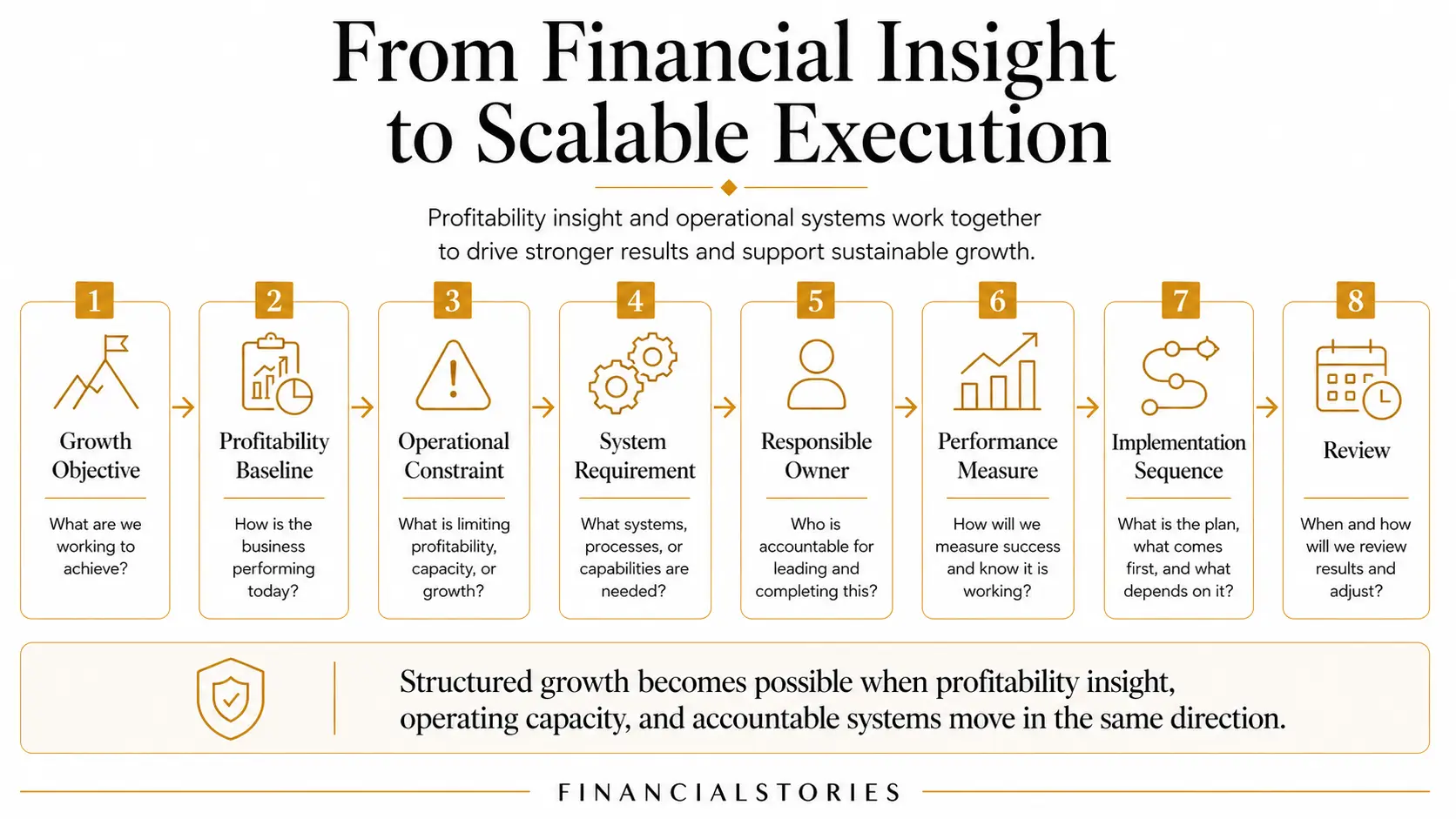
Each growth priority can move through a connected process:
Growth objective → Profitability baseline → Operational constraint → System requirement → Responsible owner → Performance measure → Implementation sequence → Review
This framework helps prevent two common problems. The first is pursuing growth without understanding whether the underlying economics support it. The second is identifying an operational problem without defining the ownership, process, and measures required to improve it. Profitability and Operational Systems connect the financial outcome to the way the business creates it.
Scalable does not mean overbuilt
- A scalable business does not need the maximum amount of process.
- It needs the right amount of structure for its size, complexity, risk, and goals.
- Too little structure can create inconsistency, rework, missed information, and dependence on individual memory.
- Too much structure can slow decisions, increase administration, and make the business less responsive.
Our approach is intentional.
- We focus on the processes that materially affect profitability, customer experience, cash flow, quality, compliance, capacity, and leadership time.
- The objective is not process for its own sake. It is a business that can grow without losing visibility or control.
Operational Systems should make the next decision easier
A useful system does more than organize tasks. It gives the right people the information, authority, and context needed to act. A scalable Operational System should help the business answer:
- What needs to happen?
- What information is required?
- Who is responsible?
- Which standards must be met?
- When is leadership approval necessary?
- What happens when an exception occurs?
- How will completion be confirmed?
- Which measure shows whether the process is working?
- When should the process be reviewed or changed?
When those questions are answered clearly, the business can operate with less uncertainty and fewer unnecessary escalations.
Building capacity before adding cost
When a business feels constrained, hiring is often treated as the immediate solution.
Sometimes additional people are necessary. In other cases, the underlying constraint may be unclear responsibilities, inefficient handoffs, inconsistent information, unnecessary approvals, or work that should be automated or eliminated.
Before adding fixed cost, we help leadership understand:
- Which work is creating the constraint
- Whether the work is necessary
- Whether responsibilities are appropriately assigned
- Whether the process can be simplified
- Whether technology can improve the workflow
- What additional capacity the new role should create
- What financial result would make the hire supportable
- How success should be measured
This helps the business hire with a clearer purpose and a stronger understanding of the expected return.
When Profitability and Operational Systems may be the right next step
This work may be especially valuable when:
- Revenue is growing, but profit is not improving at the same rate.
- Leadership cannot clearly identify which services, customers, or projects are most profitable.
- The founder remains involved in too many routine decisions.
- Important processes vary depending on who completes the work.
- Growth is increasing errors, delays, rework, or customer concerns.
- The team is busy, but leadership is uncertain whether capacity is being used effectively.
- New employees take too long to understand how work should be completed.
- Hiring has increased cost without creating the expected capacity.
- Information is stored across disconnected systems or individuals.
- The business is considering a new service, location, team, or major technology investment.
- Operational questions and financial questions are being evaluated separately.
- Leadership wants to scale without adding unnecessary complexity.
- The business is preparing for reduced owner involvement, succession, financing, or a future transaction.
The need is not always more people or more software. Often, it is a clearer understanding of how profitability, process, capacity, and accountability work together.
What stronger profitability insight and Operational Systems make possible
- A clearer understanding of how the business creates profit.
- Greater visibility into service, customer, project, or location economics.
- Pricing decisions grounded in actual delivery requirements.
- Better alignment between staffing, workload, and financial capacity.
- Fewer unnecessary exceptions, handoffs, and repeated questions.
- Clearer ownership across the organization.
- More consistent execution and customer experience.
- Less dependence on founder memory and intervention.
- Technology decisions built around defined workflows.
- Growth supported by stronger margins and operating capacity.
- A more transferable, resilient, and valuable business.
Structured growth does not happen because the business works harder. It happens because financial insight and operating systems work together.
Structured growth requires both profitability and operational capacity
Bookkeeping Services
Bookkeeping Services establish and maintain the financial record.
They answer:
What activity occurred, and has it been recorded consistently?
Controller Services
Controller Services oversee the accounting system, balance sheet, closing process, and financial reporting.
They answer:
Can the financial information be trusted, and what accounting work requires attention?
Tax Planning & Optimization
Tax Planning & Optimization evaluate the tax implications of current activity and future decisions.
They answer:
What obligations, opportunities, and timing considerations should influence the plan?
Advisory Services
Advisory Services translate financial information into forward-looking analysis and decision support.
They answer:
What does the information mean, and what should leadership consider next?
Profitability & Operational Systems
Profitability and Operational Systems connect financial results to the way work is priced, delivered, managed, and improved.
They answer:
How does the business create value, what is limiting that value, and which systems must change to support profitable scale?
Financial Strategy
Financial Strategy connects each discipline to the long-term direction and design of the business.
It answers:
How should today’s decisions, resources, and operating model work together to build the business leadership intends to create?
Build a business that can grow with greater clarity and control
Profitable growth requires more than additional revenue.
It requires a clear understanding of the economics behind the business and Operational Systems capable of supporting greater volume, stronger accountability, and more consistent execution.
Our Profitability and Operational Systems services connect financial insight with the way work actually happens, helping leadership improve today’s performance while building a stronger foundation for what comes next.
Frequently asked questions
What are Operational Systems?
They may include workflows, role definitions, standard operating procedures, approval processes, management reporting, performance measures, and supporting technology.
What is profitability consulting?
It may include analysis of pricing, direct costs, labor, margins, overhead, customers, services, projects, capacity, and cash flow. The objective is to identify what is driving profitability and where financial or operational changes may improve performance.
How do profitability and Operational Systems work together?
Operational Systems analysis explains how workflow, staffing, capacity, decision-making, and process design may be contributing to that result.
Connecting the two helps leadership improve both the financial outcome and the system producing it.
Can this work help a founder-led business become less dependent on the founder?
The goal is not to remove the founder from important decisions. It is to reduce unnecessary dependence on the founder for recurring work and routine approvals.
Does building Operational Systems mean creating more procedures?
The purpose is to create enough structure to improve consistency, accountability, and visibility without adding unnecessary administration.
Some processes may need documentation. Others may need simplification, clearer ownership, better information, or fewer approval steps.
Can profitability analysis identify which services or customers are most valuable?
This may require connecting revenue with direct costs, labor, delivery time, rework, discounts, support requirements, and other resources consumed by a service or customer.
Where the data is incomplete, the first step may be improving how that information is captured.
Can Operational Systems improve profit without reducing staff?
Profitability improvement does not always require cost cutting.
Clearer workflows, fewer errors, better pricing, reduced rework, more effective capacity use, stronger collections, and improved decision-making can all affect profitability without reducing the team.
Can you help determine whether the business needs to hire?
The process may also reveal improvements that should occur before or alongside the hire.
Do you help create standard operating procedures?
The objective is not to document every detail. It is to capture the information and decision criteria needed for important recurring work to be completed reliably.
Can this work include technology and automation?
We first evaluate what the workflow should accomplish, what information is required, and who owns the process. This helps prevent the business from automating confusion or investing in systems that do not address the actual constraint.
How is this different from Business Advisory Services?
Business Advisory Services provide broader forward-looking financial analysis and decision support.
Profitability and Operational Systems work more specifically at the intersection of financial performance and business execution. The focus is on how pricing, costs, capacity, processes, roles, and systems affect the business’s ability to grow profitably.
How is this different from Financial Strategy?
Profitability and Operational Systems may be one important part of that strategy. They focus on whether the financial model and operating system can support the direction leadership has selected.
Does the business need reliable accounting records before beginning?
When bookkeeping, account classification, job costing, or reporting is incomplete, preliminary Bookkeeping Services or Controller Services may be needed to improve the financial baseline.
Operational review can still begin, but limitations in the available data should remain visible.
Can these services guarantee improved profitability or growth?
The value of the work comes from improving financial visibility, identifying constraints, evaluating alternatives, clarifying accountability, and creating a structured implementation process. Actual results depend on business conditions, decisions, execution, and timing.
Office Locations
Nashville, TN & Coral Springs, FL
We have two office locations and we work remotely with companies nationally.